Built for
All templates
3D · Tactile systems
Soft Systems 3D
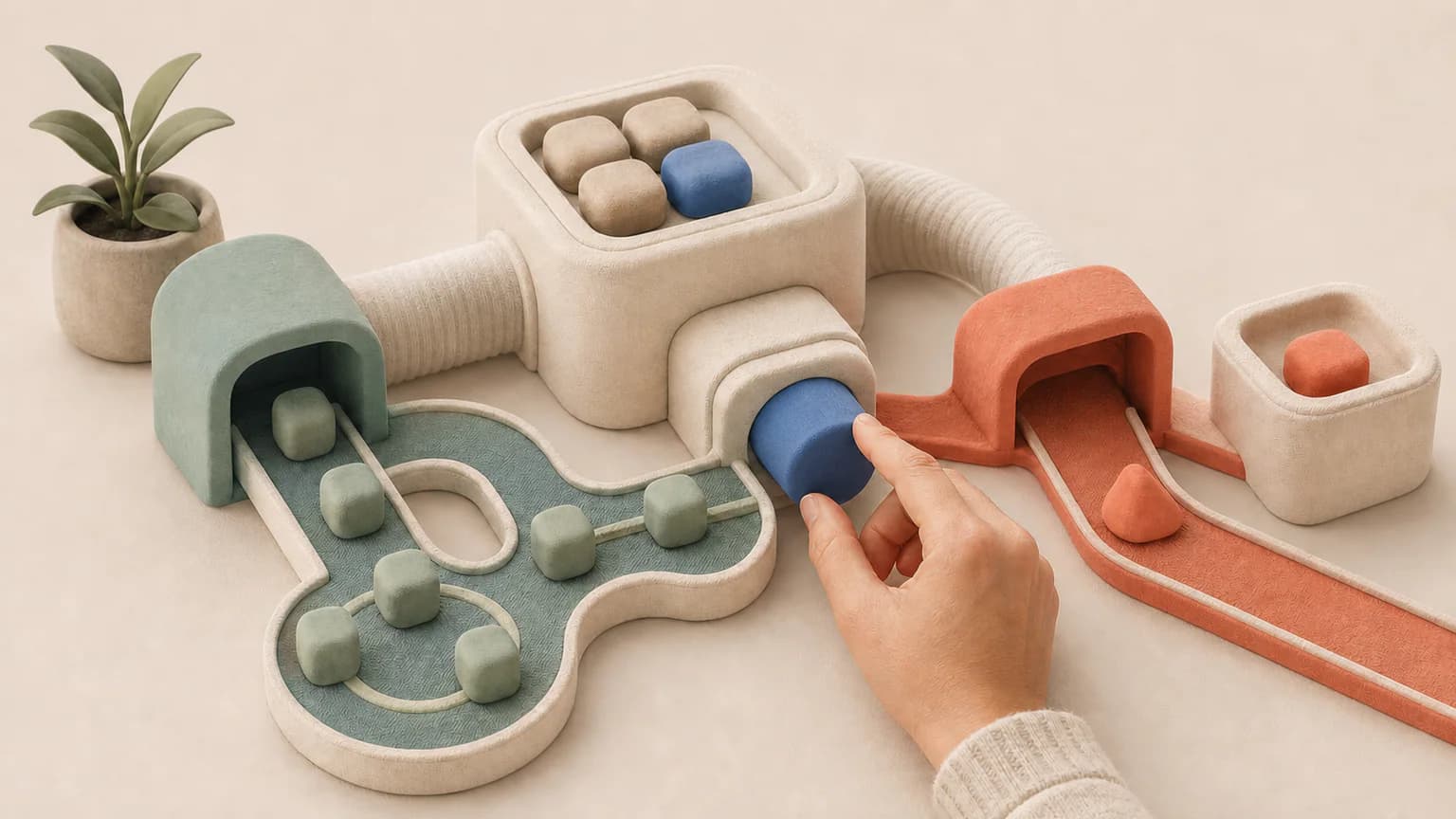
A tactile 3D Skill for workflows and product systems. Matte modules, plain physical controls, and visible routing make coordination and transformation feel concrete without borrowing the visual language of software UI.
Core palette
 3D
3DVisual traits
- Matte modules
- Physical routing
- Soft contact shadows
- Plain controls
Output defaults
- 16:9 article canvas
- One concept per image
- Editable visual briefs
Creative direction
Build the system as a physical object.
Soft Systems 3D assigns every abstract function a module, connection, selector, or container. Rounded construction and soft contact shadows make the mechanism approachable, while routing remains explicit enough to teach.
Read the illustration style guideComposition grammar
Focal metaphor
Build one dominant physical metaphor around the article's central relationship.
Every image must
- one functional modular system
- three to six major parts
- one visible transformation
- plain physical selector
Never drift into
- emoji face
- toy character
- toy catalog
- glossy plastic
Palette behavior
Palette 1: primary structure and focal subject Palette 2: supporting contrast and secondary forms Palette 3: accent for emphasis and directional cues Palette 4: restrained supporting accent
Example set
One modular machine, three stages of understanding.
Material and module scale stay consistent while routing and state changes reveal the system progressively.
3DIntroduce the modules
Make each role or stage physically distinct without turning the scene into a labeled interface.
 3D
3DRoute the active object
Show the decision or handoff through one visible channel and one state change.
 3D
3DReveal the resulting system
End with the modules working together in a stable, understandable arrangement.
How it reads an article
It reads for inputs, decisions, handoffs, and outputs.
The Skill converts a workflow into a small tabletop machine. A decision becomes a physical switch, a handoff becomes a channel, and a transformation becomes a visible change in the object moving through it.
Best fit
Use it for product education, AI workflows, automation, service design, and approachable technology explainers.
Use another Skill when
Avoid it for people-led culture stories, exact engineering, evidence-heavy reports, or premium technology that needs glass and metal precision.
How is Soft Systems 3D different from Soft Objects?
Soft Objects focuses on friendly conceptual relationships. Soft Systems 3D is more procedural: modules have explicit functions, routes connect stages, and a visible state change explains how the workflow operates.
Under the surface
More than a prompt.
Each Zyncli template carries a complete set of reusable creative decisions.
Open-source SkillInstall Soft Systems 3D from GitHub- 01
Article planning
Rules for choosing the passages that benefit most from an illustration.
- 02
Visual DNA
Composition, palette, subjects, line, texture, typography, and negative rules.
- 03
Prompt compiler
A structured translation from each visual brief into a model-ready instruction.
- 04
Quality checks
A template-specific rubric applied before the illustration reaches your gallery.
Continue exploring
Other visual languages.


Ready to use Soft Systems 3D?