Built for
All templates
Explainer · Inventor sketch
Technical Field Notes
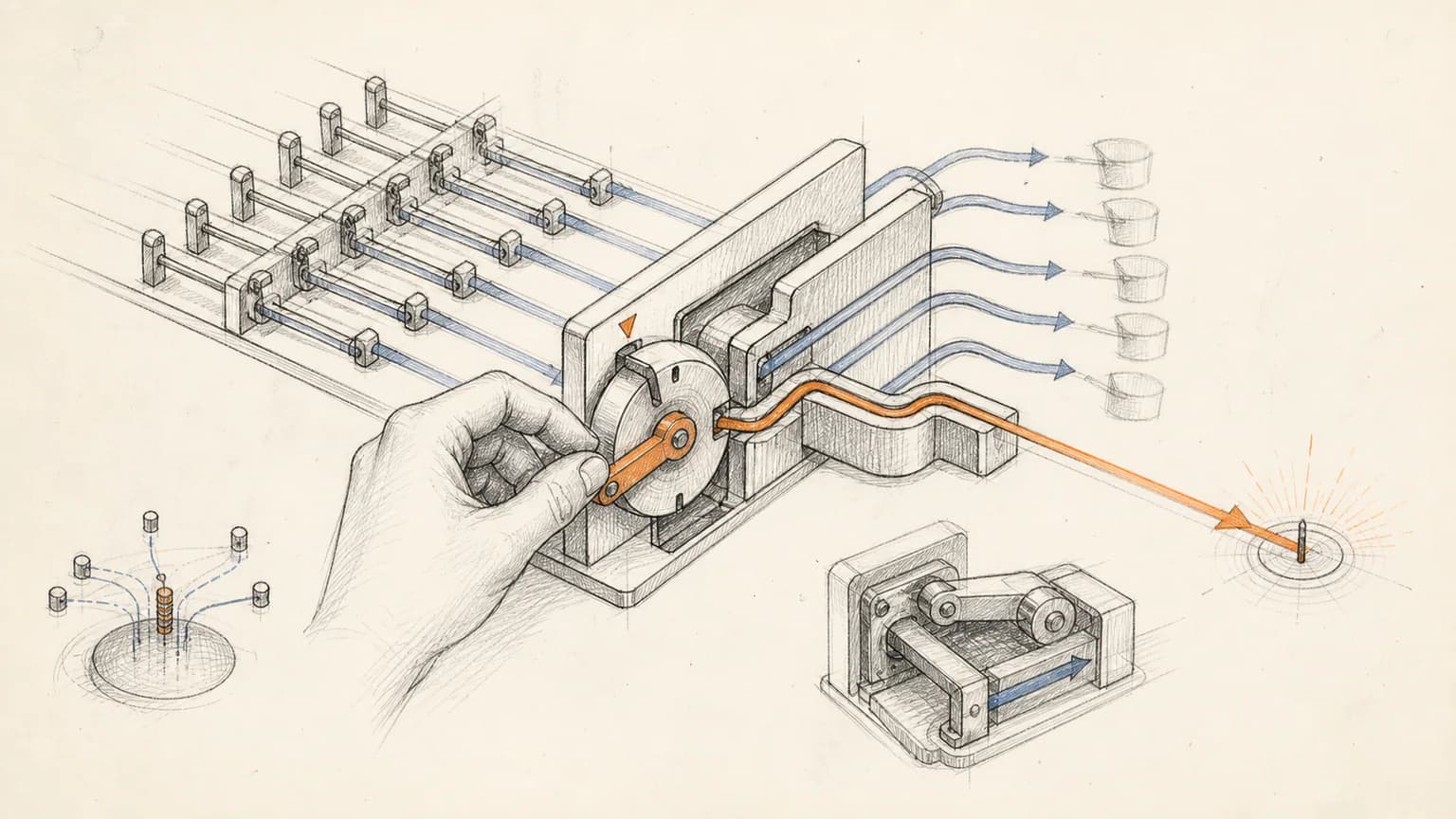
An inventor-sketch Skill for workflows, systems, and technical choices. Graphite studies, cutaway mechanisms, and sparse functional color make causality tangible without pretending to be an engineering drawing.
Core palette
 Explainer
Visual traits
- Graphite studies
- Cutaway mechanisms
- Functional accents
- Paper field
Output defaults
- 16:9 article canvas
- One concept per image
- Editable visual briefs
Creative direction
Explain the mechanism, including where it can fail.
Technical Field Notes translates a system into believable moving parts, inputs, selectors, and outputs. Exploratory marks show thinking, while the final ink path clarifies the relationship the reader needs to retain.
Read the illustration style guideComposition grammar
Focal metaphor
Build one dominant physical metaphor around the article's central relationship.
Every image must
- one central invented mechanism
- no more than two supporting studies
- believable functional relationship
- visible graphite-to-ink hierarchy
Never drift into
- CAD render
- patent-copy imitation
- blueprint cliché
- school worksheet
Palette behavior
Palette 1: primary structure and focal subject Palette 2: supporting contrast and secondary forms Palette 3: accent for emphasis and directional cues Palette 4: restrained supporting accent
Example set
A system opened up like an inventor's notebook.
Graphite exploration and functional accents stay consistent while each frame reveals another causal layer.
ExplainerIdentify the components
Sketch the minimum parts needed to understand the starting state and system boundary.
 Explainer
Open the mechanism
Use a cutaway or routing view to show where the transformation actually occurs.
 Explainer
Trace the output
Follow the consequence through the machine, including friction or loss when it matters.
How it reads an article
It reads for cause, routing, and transformation.
A model pipeline might become a set of chambers with visible handoffs; a decision process might become a selector that changes the route. The invented mechanism is judged by explanatory truth, not literal realism.
Best fit
Use it for AI workflows, product systems, technical explainers, operations, and articles that compare how mechanisms behave.
Use another Skill when
Avoid it for emotional storytelling, photographic evidence, polished consumer campaigns, or content requiring formally accurate schematics.
Why use an invented mechanism instead of a conventional diagram?
A physical mechanism makes causality easier to imagine while preserving editorial character. The Skill remains honest by avoiding engineering precision and using only the parts needed to explain the article's relationship.
Under the surface
More than a prompt.
Each Zyncli template carries a complete set of reusable creative decisions.
Open-source SkillInstall Technical Field Notes from GitHub- 01
Article planning
Rules for choosing the passages that benefit most from an illustration.
- 02
Visual DNA
Composition, palette, subjects, line, texture, typography, and negative rules.
- 03
Prompt compiler
A structured translation from each visual brief into a model-ready instruction.
- 04
Quality checks
A template-specific rubric applied before the illustration reaches your gallery.
Continue exploring
Other visual languages.

Ready to use Technical Field Notes?