Built for
All templates
Explainer · Engineering schematic
Precision Circuit
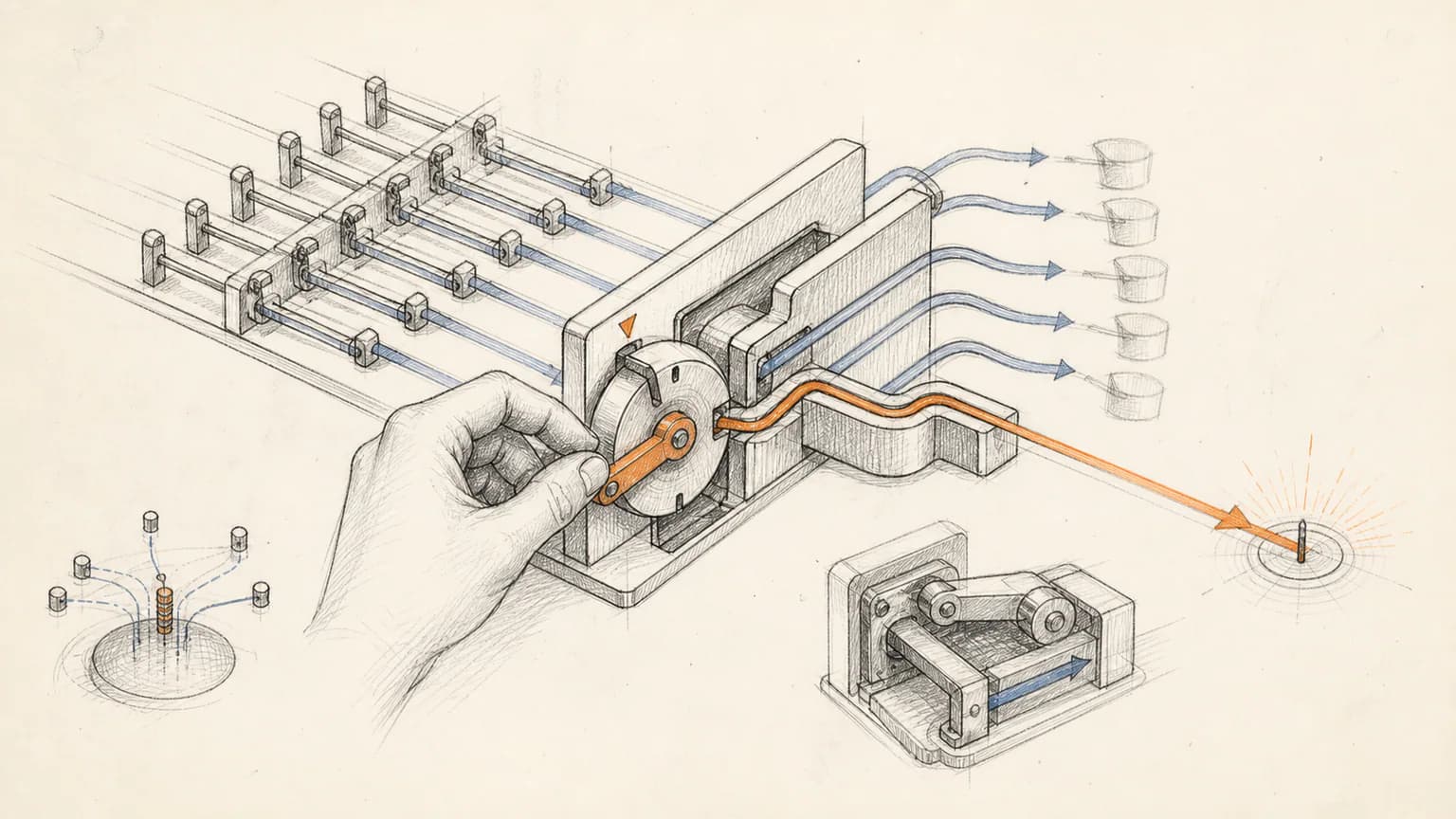
A strict technical illustration Skill for infrastructure, orchestration, and control. Orthogonal traces make dependencies auditable, while one highlighted route tells the reader which mechanism matters now.
Core palette
 Explainer
Visual traits
- Orthogonal routing
- Measured modules
- Functional annotation
- Engineering discipline
Output defaults
- 16:9 article canvas
- One concept per image
- Editable visual briefs
Creative direction
If a line has no job, remove it.
Precision Circuit begins with boundaries, endpoints, and the active signal path. It refuses decorative circuit texture: every junction must be traceable and every module must have a role in the explanation.
Read the illustration style guideComposition grammar
Focal metaphor
Build one dominant physical metaphor around the article's central relationship.
Every image must
- each line has a start and endpoint
- junction logic is unambiguous
- one active path dominates
- module hierarchy is measurable
Never drift into
- random circuit-board texture
- motherboard illustration
- cyberpunk interface
- dashboard
Palette behavior
Palette 1: primary structure and focal subject Palette 2: supporting contrast and secondary forms Palette 3: accent for emphasis and directional cues Palette 4: restrained supporting accent
Example set
A technical story followed from boundary to outcome.
Trace weight, module scale, and annotation rules remain stable while the active route changes.
ExplainerDefine the boundary
Show where the system begins and ends before introducing internal complexity.
 Explainer
Follow the active path
Highlight the route carrying the article's central mechanism and subordinate all alternatives.
 Explainer
Reveal the control point
End on the gate, junction, or feedback path with the greatest leverage.
How it reads an article
It converts prose into routing logic.
A bottleneck becomes a constrained bus; failover becomes a second path that activates at one junction. Sparse real labels support the structure without turning the image into documentation.
Best fit
Use it for AI workflows, infrastructure, APIs, cybersecurity, operations, and product systems with a real sequence or dependency.
Use another Skill when
Avoid it for emotional narratives, speculative atmosphere, broad cultural arguments, or systems too complex to simplify honestly into one image.
How is Precision Circuit different from a circuit-board background?
The routing is semantic, not decorative. A reader can follow the relevant path, identify its boundary and control point, and understand the technical relationship without parsing an actual engineering schematic.
Under the surface
More than a prompt.
Each Zyncli template carries a complete set of reusable creative decisions.
- 01
Article planning
Rules for choosing the passages that benefit most from an illustration.
- 02
Visual DNA
Composition, palette, subjects, line, texture, typography, and negative rules.
- 03
Prompt compiler
A structured translation from each visual brief into a model-ready instruction.
- 04
Quality checks
A template-specific rubric applied before the illustration reaches your gallery.
Continue exploring
Other visual languages.

Ready to use Precision Circuit?