Built for
All templates
Explainer · Industrial section
Process Cutaway
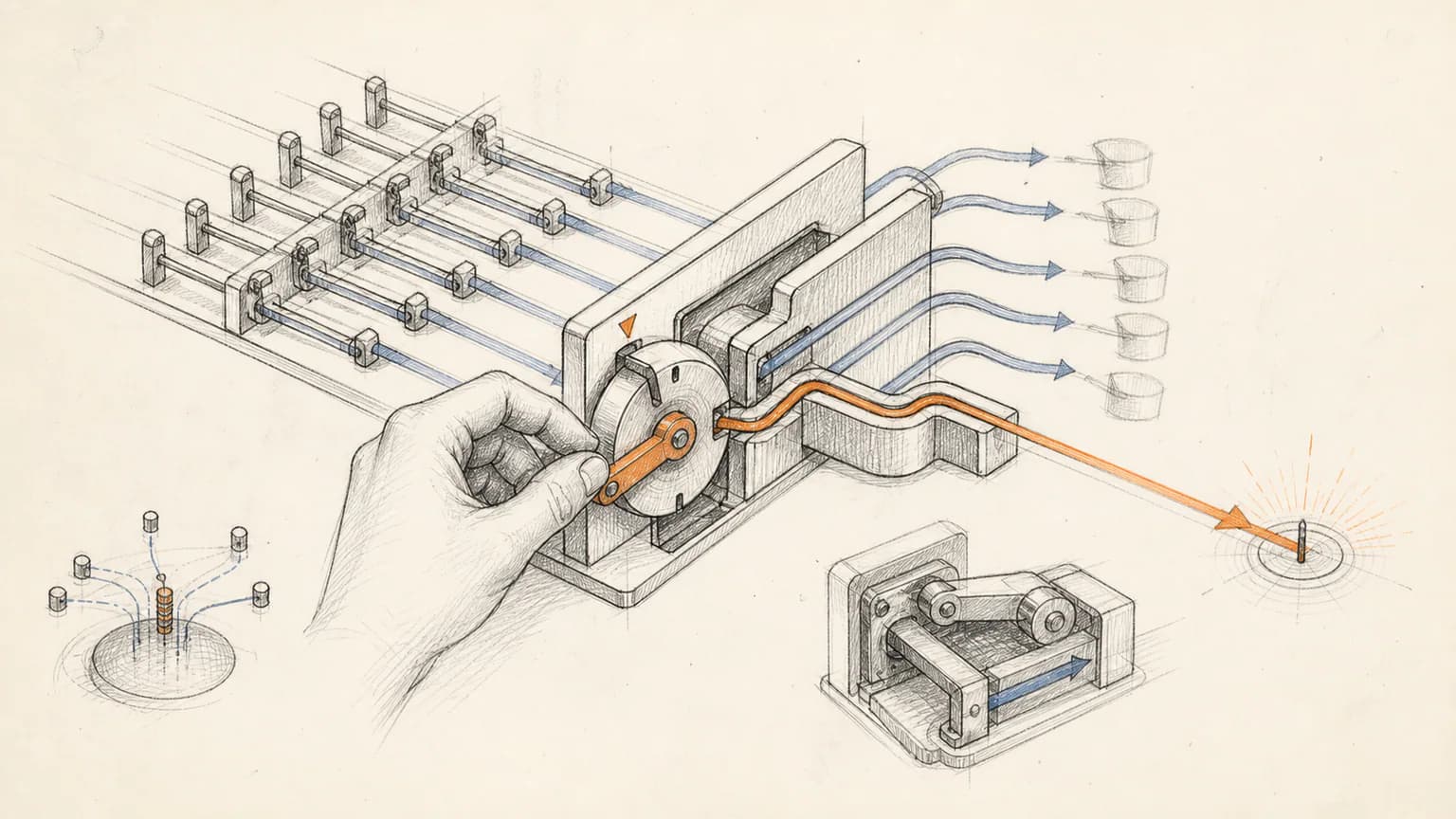
A scientific cutaway Skill for articles that must reveal what happens inside a process. One original instrument exposes its chambers, gates, and output path without pretending to be a real patented machine.
Core palette
 Explainer
Visual traits
- Cutaway section
- Visible transformation
- Functional chambers
- Sparse annotation
Output defaults
- 16:9 article canvas
- One concept per image
- Editable visual briefs
Creative direction
Reveal the transformation, not every component.
Process Cutaway starts with input, state change, and output. It invents only the minimum mechanism required to make that change believable, then sections the housing along one consistent plane.
Read the illustration style guideComposition grammar
Focal metaphor
Build one dominant physical metaphor around the article's central relationship.
Every image must
- input-to-output path is visible
- internal stages have distinct functions
- cutaway plane is consistent
- one active transformation
Never drift into
- patent drawing copy
- steampunk machine
- spaceship blueprint
- dense engineering manual
Palette behavior
Palette 1: primary structure and focal subject Palette 2: supporting contrast and secondary forms Palette 3: accent for emphasis and directional cues Palette 4: restrained supporting accent
Example set
A process inspected from intake to release.
Section style and callout logic remain stable while the internal operation and failure point change.
ExplainerIdentify the intake
Show the incoming material and the first boundary it encounters.
 Explainer
Expose the critical chamber
Center the stage where the article's meaningful transformation occurs.
 Explainer
Trace the verified output
Close with the exit state and any essential feedback path.
How it reads an article
It gives invisible operations an inspectable interior.
A moderation pipeline can become successive filtering chambers; a learning loop can become a calibration drum with a visible return path. Sparse labels clarify stages the drawing cannot name alone.
Best fit
Use it for technical processes, operations, AI pipelines, manufacturing logic, quality systems, and detailed how-it-works articles.
Use another Skill when
Avoid it for emotional essays, broad cultural commentary, documentary evidence, or topics where inventing a mechanism would mislead readers.
How can an invented cutaway remain trustworthy?
It never invents factual specifications. The instrument is explicitly conceptual, mechanically coherent, and limited to the relationships stated in the article, with labels drawn only from supplied material.
Under the surface
More than a prompt.
Each Zyncli template carries a complete set of reusable creative decisions.
- 01
Article planning
Rules for choosing the passages that benefit most from an illustration.
- 02
Visual DNA
Composition, palette, subjects, line, texture, typography, and negative rules.
- 03
Prompt compiler
A structured translation from each visual brief into a model-ready instruction.
- 04
Quality checks
A template-specific rubric applied before the illustration reaches your gallery.
Continue exploring
Other visual languages.

Ready to use Process Cutaway?