Built for
All templates
Workplace · Narrative illustration
Connected Rooms
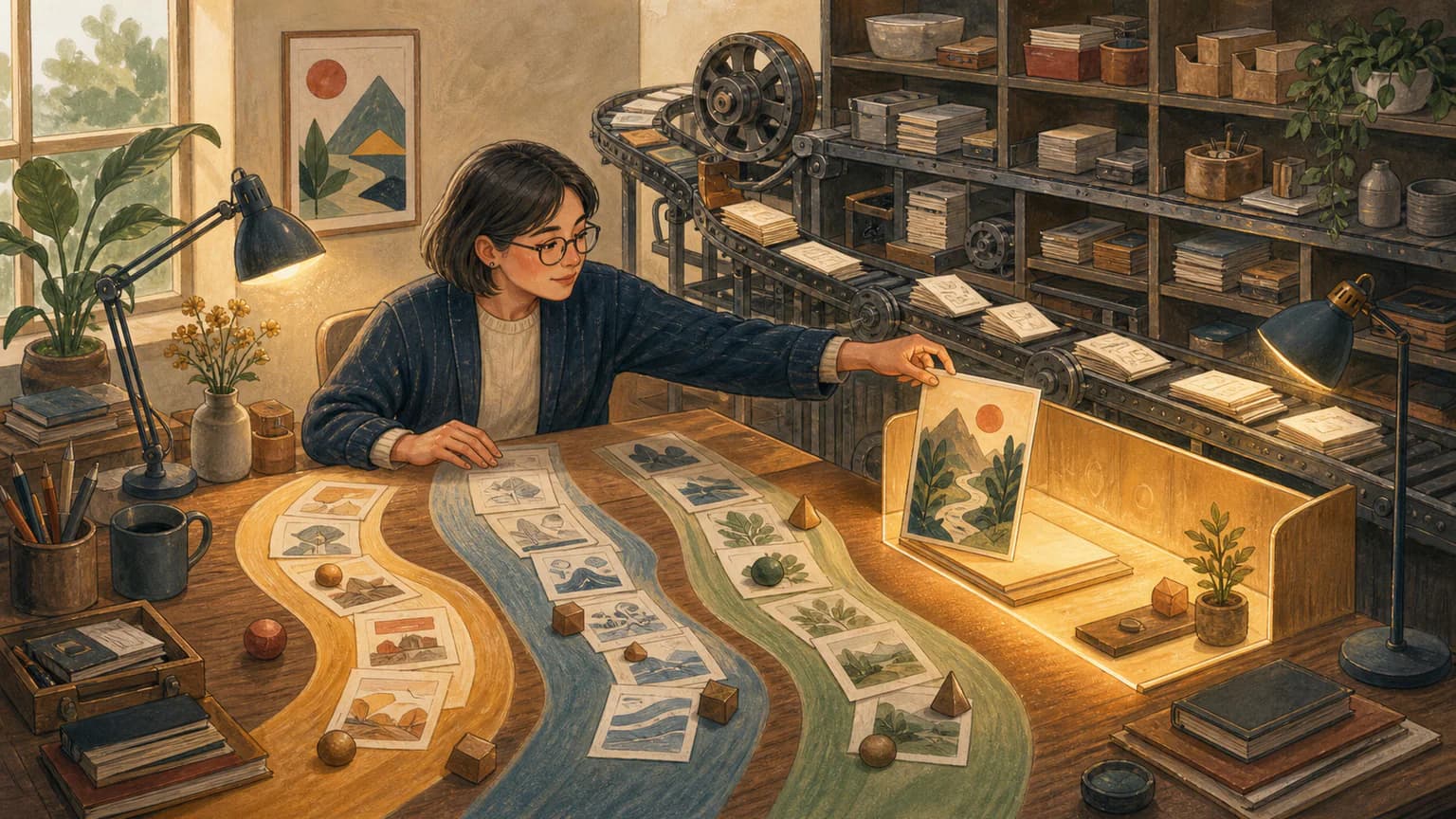
A warm narrative Skill for distributed work, online communities, and collaboration. Separate rooms give each participant a real activity; shared objects and signals reveal how the whole system stays connected.
Core palette
 Workplace
Visual traits
- Modular rooms
- Observed activity
- Warm palette
- Connected narrative
Output defaults
- 16:9 article canvas
- One concept per image
- Editable visual briefs
Creative direction
Show collaboration as coordinated work, not a meeting.
Connected Rooms divides the article into a small set of complementary roles. Each room contains one task with visible purpose, and only the relationships that change the shared outcome are drawn between them.
Read the illustration style guideComposition grammar
Focal metaphor
Build one dominant physical metaphor around the article's central relationship.
Every image must
- three to five distinct rooms
- one specific activity per room
- one visible cross-room relationship
- credible adult gestures
Never drift into
- video-call screenshot
- generic happy remote team
- social network UI
- house cutaway clutter
Palette behavior
Palette 1: primary structure and focal subject Palette 2: supporting contrast and secondary forms Palette 3: accent for emphasis and directional cues Palette 4: restrained supporting accent
Example set
Three rooms, one outcome.
Room grammar and palette unify the set while participants, tasks, and cross-room dependencies change.
WorkplaceDefine the distinct roles
Give each room one credible contribution so the reader can see why separation exists.
 Workplace
Trace the important handoff
Connect only the tasks whose timing, interpretation, or output depends on one another.
 Workplace
Reveal the shared result
Show how distributed actions assemble into an outcome no single room could produce.
How it reads an article
It makes distance spatially understandable.
A remote handoff can become an object moving through adjacent rooms; community learning can become a repeated practice evolving from window to window. The composition explains contribution without imitating video-call software.
Best fit
Use it for remote work, team culture, creator communities, distributed learning, service organizations, and collaborative processes.
Use another Skill when
Avoid it for solitary reflection, high-stakes documentary stories, precise architecture, or technical networks that need engineering accuracy.
Why not illustrate remote work as a video call?
A call shows presence but rarely shows contribution. Connected Rooms depicts the actual work, roles, and handoffs, making collaboration legible as a system rather than a grid of faces.
Under the surface
More than a prompt.
Each Zyncli template carries a complete set of reusable creative decisions.
- 01
Article planning
Rules for choosing the passages that benefit most from an illustration.
- 02
Visual DNA
Composition, palette, subjects, line, texture, typography, and negative rules.
- 03
Prompt compiler
A structured translation from each visual brief into a model-ready instruction.
- 04
Quality checks
A template-specific rubric applied before the illustration reaches your gallery.
Continue exploring
Other visual languages.

Ready to use Connected Rooms?