Built for
All templates
Editorial · Painterly archive
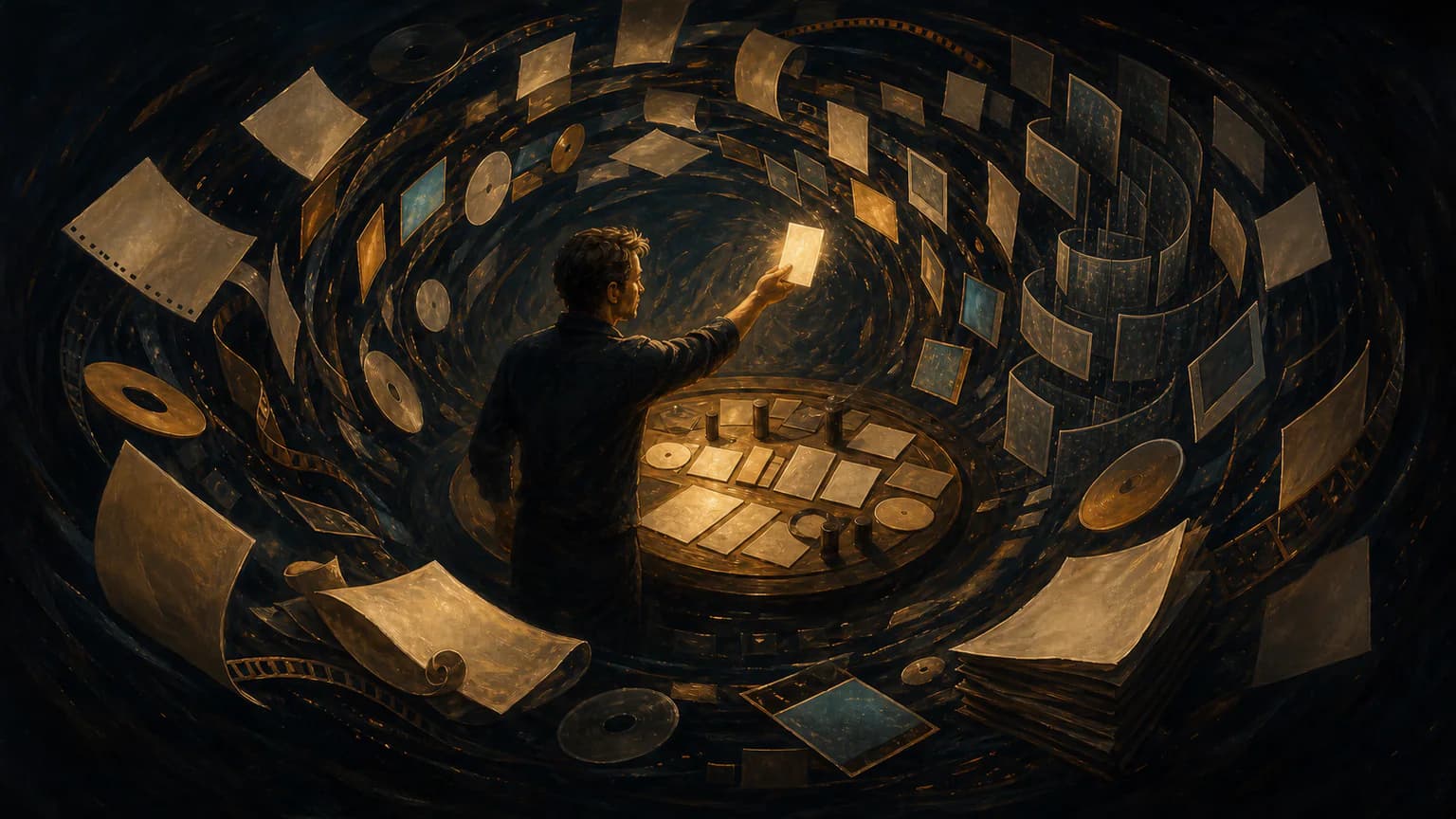
Media Vortex
A dark painterly Skill for attention, information overload, and changing media systems. Circular flows of blank media forms, amber hierarchy, and one human act of selection make the information environment feel physical without becoming cyberpunk.
Core palette
 Editorial
Visual traits
- Painterly vortex
- Analog-digital contrast
- Tactile archive
- Light hierarchy
Output defaults
- 16:9 article canvas
- One concept per image
- Editable visual briefs
Creative direction
Turn the media environment into a force with direction.
Media Vortex maps how content accumulates, circulates, and competes for attention. Repetition creates pressure; changes in light identify what is selected, ignored, or amplified; one human figure gives the system consequence.
Read the illustration style guideComposition grammar
Focal metaphor
Build one dominant physical metaphor around the article's central relationship.
Every image must
- one circular information flow
- one human decision
- one quiet focal center
- original blank media forms
Never drift into
- branded device
- smartphone
- television
- newspaper
Palette behavior
Palette 1: primary structure and focal subject Palette 2: supporting contrast and secondary forms Palette 3: accent for emphasis and directional cues Palette 4: restrained supporting accent
Example set
An information ecosystem seen from inside the flow.
Circular motion, painterly depth, and amber selection cues unify the sequence as pressure and agency change.
EditorialEstablish the volume
Build the field of repeated media forms before showing who or what controls their movement.
 Editorial
Reveal the selection force
Use light and direction to show how attention is filtered, captured, or redirected.
 Editorial
Return to human agency
Close on the act of choosing, resisting, or reorganizing the flow.
How it reads an article
It reads for volume, circulation, and choice.
The Skill identifies what enters the information field, how it moves, and where a person or institution intervenes. Blank media forms keep the image about the system rather than a collage of recognizable platforms.
Best fit
Use it for media criticism, attention economics, information overload, digital culture, recommendation systems, and publishing strategy.
Use another Skill when
Avoid it for light product education, individual portrait stories, strict process diagrams, or content that needs literal platform screenshots.
Why use blank media forms instead of recognizable platform imagery?
Blank forms keep the visual argument focused on circulation and attention rather than on a particular company. They also prevent the set from becoming dated, derivative, or dependent on third-party interfaces.
Under the surface
More than a prompt.
Each Zyncli template carries a complete set of reusable creative decisions.
Open-source SkillInstall Media Vortex from GitHub- 01
Article planning
Rules for choosing the passages that benefit most from an illustration.
- 02
Visual DNA
Composition, palette, subjects, line, texture, typography, and negative rules.
- 03
Prompt compiler
A structured translation from each visual brief into a model-ready instruction.
- 04
Quality checks
A template-specific rubric applied before the illustration reaches your gallery.
Continue exploring
Other visual languages.

Ready to use Media Vortex?